Radial Teukolsky tutorial#
Load pybhpt.radial#
from pybhpt.radial import RadialTeukolsky
import numpy as np
import matplotlib.pyplot as plt
import matplotlib as mpl
Solving the homogeneous radial Teukolsky equation in Kerr spacetime#
The RadialTeukolsky class solves the homogeneous radial Teukolsky equation
\(s\) : spin-weight of the perturbation
\(j\) : the spheroidal polar mode number
\(m\) : the azimuthal mode number
\(a\) : the dimensionless Kerr spin parameter
\(\omega\) : the frequency
where \(\Delta=r^2-2Mr+a^2\), \(K=(r^2+a^2)\omega-ma\), and \(\lambda_{sjm\omega}\) is the spheroidal eigenvalue (separation constant).
In particular we construct the homogeneous solutions \(R^\mathrm{In}_{sjm\omega}\) and \(R^\mathrm{Up}_{sjm\omega}\), which correspond to the asymptotic boundary conditions
To construct the solutions for some set of radial points \(r\), we first instantiate the class with the Teukolsky parameters \((s, j, m, a, \omega)\) and the points \(r\),
s, j, m, a, omega = -2, 12, 3, 0.99, 2.2
r_hor = 1 + np.sqrt(1 - a**2)
r_grid = np.linspace(r_hor + 2, 100, 3000)
Rt = RadialTeukolsky(s, j, m, a, omega, r_grid)
then we call the solve() method
Rt.solve()
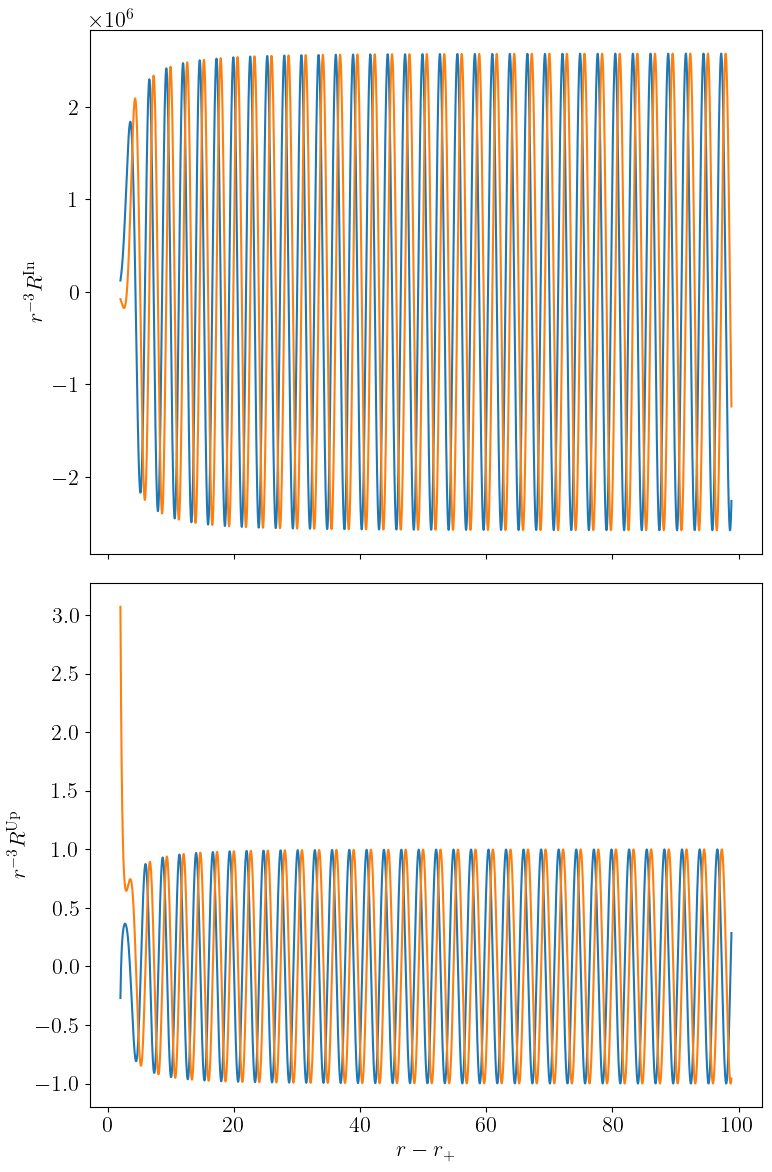
We can then plot the real and imaginary parts of our solutions
mpl.rcParams['text.usetex'] = True
mpl.rcParams['font.family'] = 'serif'
mpl.rcParams['font.size'] = 16

Rin = Rt.radialsolutions('In')
Rup = Rt.radialsolutions('Up')
Delta = r_grid**2 - 2 * r_grid + a**2

fig, axs = plt.subplots(2, 1, figsize=(8, 12), sharex=True)
axs[0].plot(r_grid - r_hor, Rin.real*r_grid**(-3), label='Re')
axs[0].plot(r_grid - r_hor, Rin.imag*r_grid**(-3), label='Im')
axs[0].set_ylabel(r'$r^{-3} R^\mathrm{In}$')

axs[1].plot(r_grid - r_hor, Rup.real*r_grid**(-3), label='Re')
axs[1].plot(r_grid - r_hor, Rup.imag*r_grid**(-3), label='Im')
axs[1].set_ylabel(r'$r^{-3} R^\mathrm{Up}$')
axs[1].set_xlabel(r'$r - r_+$')

plt.tight_layout()
plt.show()