Teukolsky point-particle mode tutorial#
Load pybhpt.teuk#
from pybhpt.teuk import TeukolskyMode
from pybhpt.geo import KerrGeodesic
import numpy as np
import matplotlib.pyplot as plt
import matplotlib as mpl
Solving the inhomogeneous radial Teukolsky equation in Kerr spacetime#
The TeukolskyMode class constructs modes of the so-called extended homogeneous solutions to the radial Teukolsky equation for a point-particle source on a bound periodic geodesic,
The class is instantiated with the input parameters
\(s\) : spin-weight of the perturbation
\(j\) : the spheroidal polar mode number
\(m\) : the azimuthal mode number
\(k\) : the polar mode number
\(n\) : the radial mode number
along with an instance of the KerrGeodesic class that captures the motion of the source.
a, p, e, x = 0.99, 5, 0.6, 0.4
geo = KerrGeodesic(a, p, e, x)
s, j, m, k, n = -2, 12, 3, 1, 2
Psis = TeukolskyMode(s, j, m, k, n, geo)
We solve for the mode solutions and the Teukolsky amplitudes with the solve() method
Psis.solve(geo)
Accessing Teukolsky amplitudes#
The Teukolsky amplitudes are easily accessible through the class method amplitude(bc) for a given boundary condition bc.
Psis.amplitude('In'), Psis.amplitude('Up')
((-7.722257033945276e-16+2.1438981566064308e-15j),
 (-1.0298101162765425e-13-8.926429485261111e-13j))
Due to the highly-oscillatory nature of the source integrand, the Teukolsky amplitudes are highly susceptible to numerical errors that arise from catastrophic cancellation when solving the source integral. Therefore, the class also provides an estimate of fractional numerical error in the amplitudes, which is accessed through the precision(bc) method.
Psis.precision('In'), Psis.precision('Up')
(8.635931505264635e-13, 5.361783459428641e-11)
Plotting mode solutions#
Radial solutions#
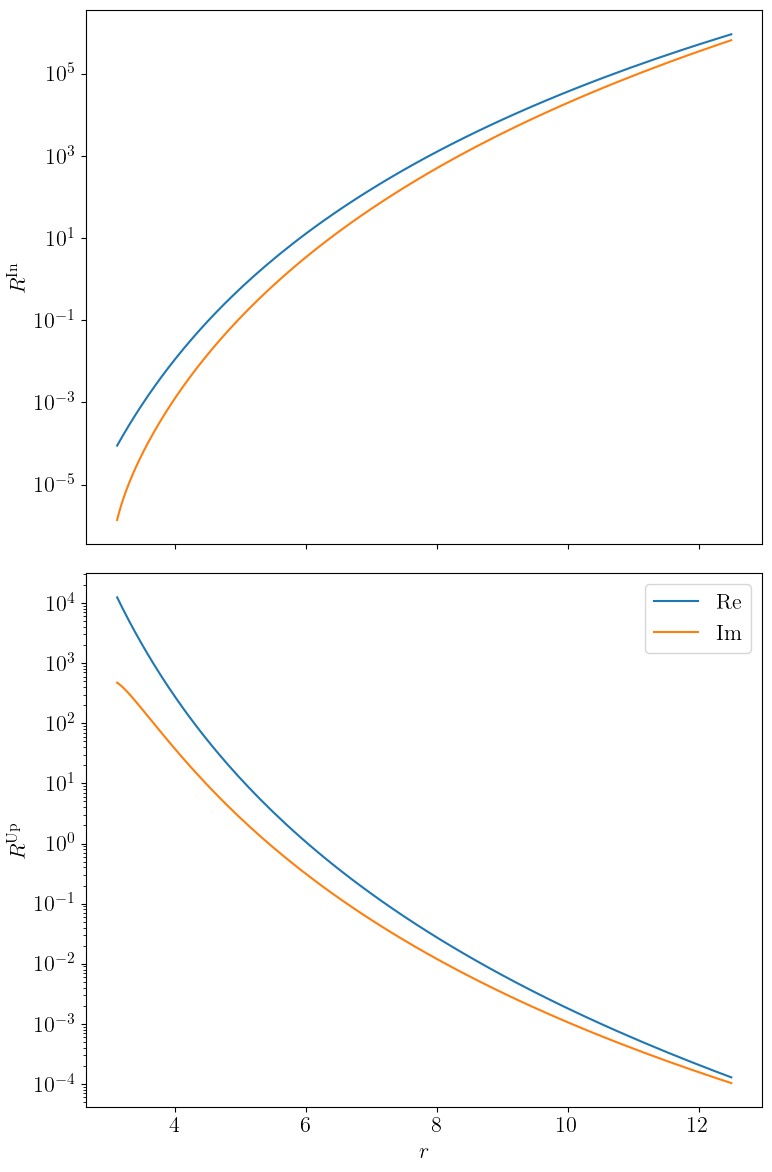
We can then plot the real and imaginary parts of our extended radial solutions inside the source region
mpl.rcParams['text.usetex'] = True
mpl.rcParams['font.family'] = 'serif'
mpl.rcParams['font.size'] = 16

r_grid = np.array([Psis.radialpoint(i) for i in range(geo.nsamples // 2)])
Rin = np.array([Psis.radialsolution('In', i) for i in range(len(r_grid))])
Rup = np.array([Psis.radialsolution('Up', i) for i in range(len(r_grid))])

fig, axs = plt.subplots(2, 1, figsize=(8, 12), sharex=True)
axs[0].plot(r_grid, np.abs(Rin.real), label='Re')
axs[0].plot(r_grid, np.abs(Rin.imag), label='Im')
axs[0].set_ylabel(r'$R^\mathrm{In}$')
axs[0].set_yscale('log')

axs[1].plot(r_grid, np.abs(Rup.real), label='Re')
axs[1].plot(r_grid, np.abs(Rup.imag), label='Im')
axs[1].set_ylabel(r'$R^\mathrm{Up}$')
axs[1].set_xlabel(r'$r$')
axs[1].set_yscale('log')

plt.legend()
plt.tight_layout()
plt.show()
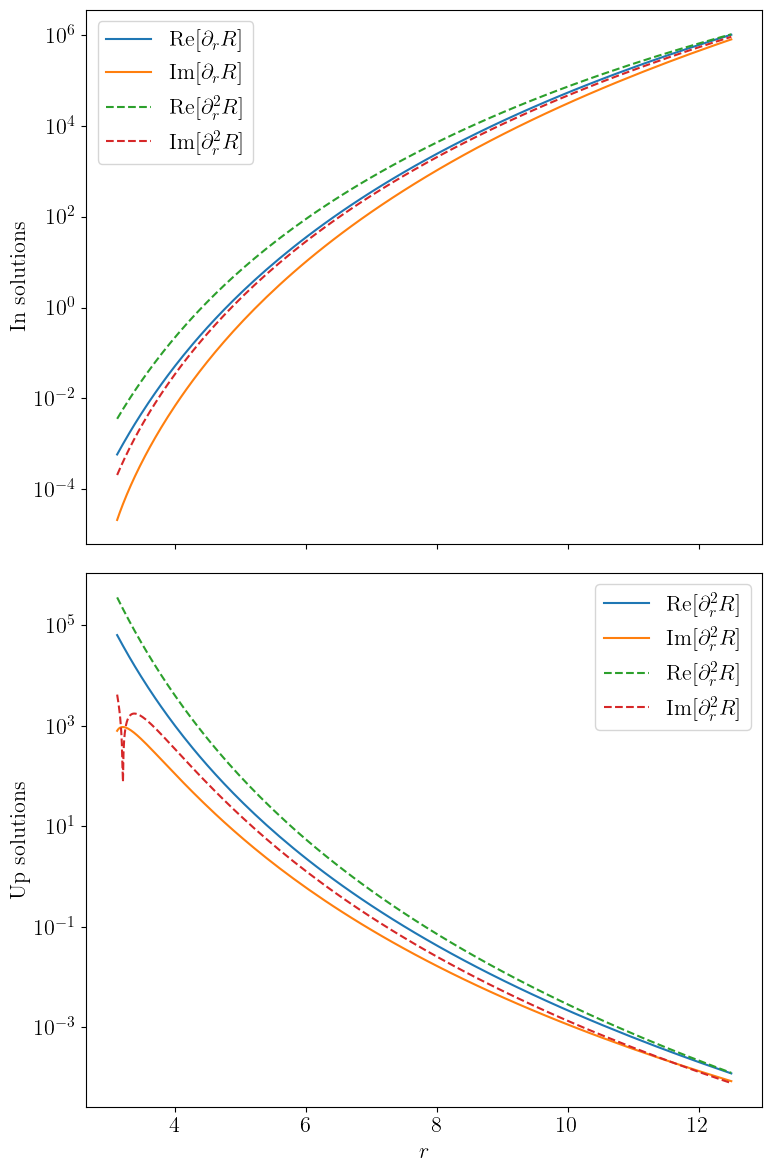
and their derivatives
dRin = np.array([Psis.radialderivative('In', i) for i in range(len(r_grid))])
dRup = np.array([Psis.radialderivative('Up', i) for i in range(len(r_grid))])
d2Rin = np.array([Psis.radialderivative2('In', i) for i in range(len(r_grid))])
d2Rup = np.array([Psis.radialderivative2('Up', i) for i in range(len(r_grid))])

fig, axs = plt.subplots(2, 1, figsize=(8, 12), sharex=True)
axs[0].plot(r_grid, np.abs(dRin.real), label='Re$[\partial_r R]$')
axs[0].plot(r_grid, np.abs(dRin.imag), label='Im$[\partial_r R]$')
axs[0].plot(r_grid, np.abs(d2Rin.real), '--', label='Re$[\partial_r^2 R]$')
axs[0].plot(r_grid, np.abs(d2Rin.imag), '--', label='Im$[\partial_r^2 R]$')
axs[0].set_ylabel(r'In solutions')
axs[0].set_yscale('log')
axs[0].legend()

axs[1].plot(r_grid, np.abs(dRup.real), label='Re$[\partial_r^2 R]$')
axs[1].plot(r_grid, np.abs(dRup.imag), label='Im$[\partial_r^2 R]$')
axs[1].plot(r_grid, np.abs(d2Rup.real), '--', label='Re$[\partial_r^2 R]$')
axs[1].plot(r_grid, np.abs(d2Rup.imag), '--', label='Im$[\partial_r^2 R]$')
axs[1].set_ylabel(r'Up solutions')
axs[1].set_xlabel(r'$r$')
axs[1].set_yscale('log')

axs[1].legend()
plt.tight_layout()
plt.show()
Spheroidal solutions#
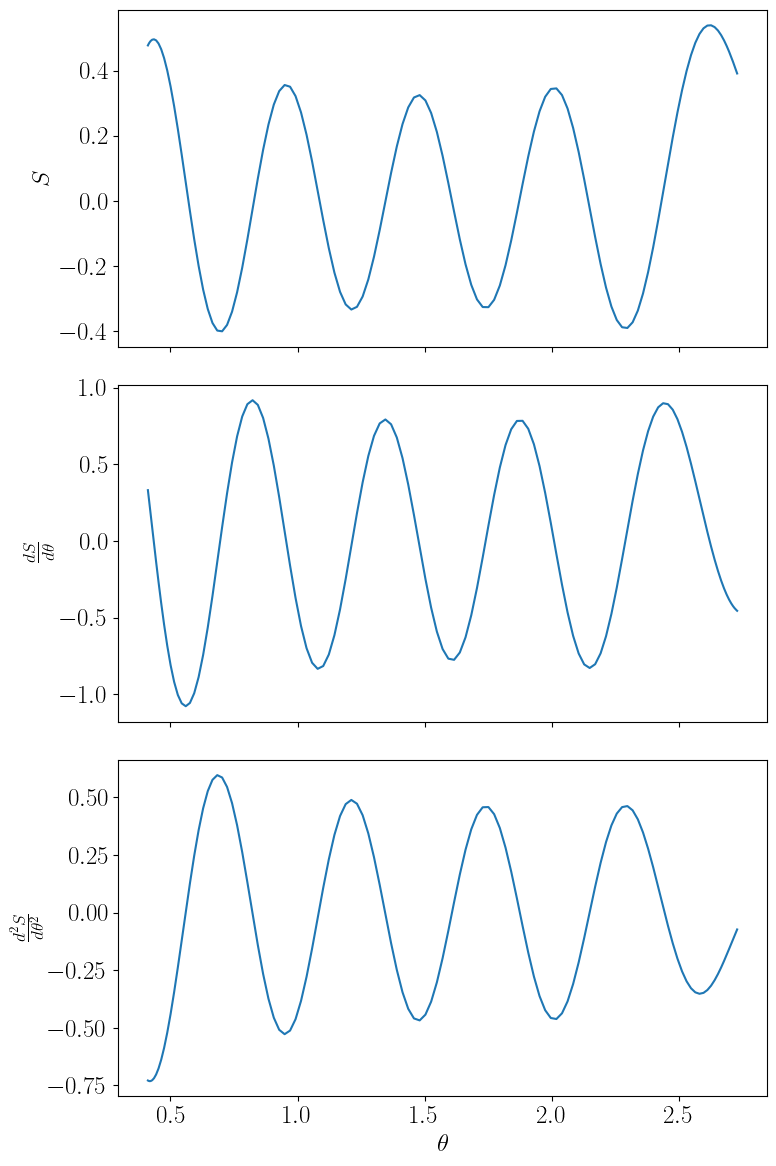
Similarly, we can plot the polar solution and its derivatives inside the source region
mpl.rcParams['text.usetex'] = True
mpl.rcParams['font.family'] = 'serif'
mpl.rcParams['font.size'] = 18

th_grid = np.array([Psis.polarpoint(i) for i in range(geo.nsamples // 2)])
S = np.array([Psis.polarsolution(i) for i in range(len(th_grid))])
dS = np.array([Psis.polarderivative(i) for i in range(len(th_grid))])
d2S = np.array([Psis.polarderivative2(i) for i in range(len(th_grid))])

fig, axs = plt.subplots(3, 1, figsize=(8, 12), sharex=True)
axs[0].plot(th_grid, S, label='S')
axs[1].plot(th_grid, dS/5, label=r"$\frac{dS}{d\theta}$")
axs[2].plot(th_grid, d2S/100, label=r"$\frac{d^2S}{d\theta^2}$")
axs[0].set_ylabel(r'$S$')
axs[1].set_ylabel(r'$\frac{dS}{d\theta}$')
axs[2].set_ylabel(r'$\frac{d^2S}{d\theta^2}$')
axs[2].set_xlabel(r'$\theta$')

plt.tight_layout()
plt.show()